
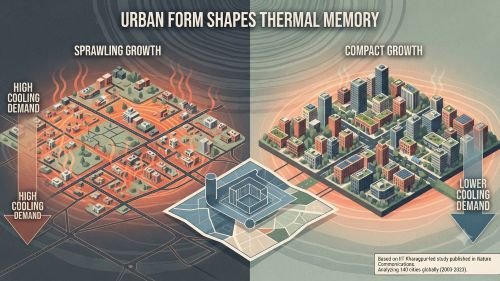
A new international study led by researchers at the Indian Institute of Technology – Kharagpur, reveals that urban growth patterns and city planning are just as important as climate change in driving future cooling demand.
Published in Nature Communications, the research was authored by PhD scholar Nilabhra Mondal and Prashant Anand, alongside global experts. The team analysed two decades of satellite and climate data, spanning 88 Indian cities and 52 representative urban centres worldwide from 2003 to 2023.
The study suggests cities develop “thermal memory”, implying that the decisions made decades ago regarding land use, building heights, and urban expansion continue to influence present-day temperatures and energy consumption.
Cities experiencing rapid, irregular and sprawling spatial expansion record the fastest increases in cooling demand. In contrast, relatively compact urban forms exhibit much slower growth in energy requirements for cooling. Furthermore, medium-sized cities continue to show some of the highest overall cooling needs.
The researchers emphasise that rising reliance on air conditioning is not an inevitable consequence of global warming alone. Urban morphology, population density, and volumetric densification play independent roles in shaping heat exposure.
Experts highlight that as urbanisation accelerates, climate-responsive planning — such as preserving green spaces, managing urban sprawl, and promoting compact development — will be vital to strengthening energy resilience and moderating future cooling demands.
(This report was drafted with the assistance of AI and verified by a human editor.)
Source: PIB/Aug 5, 2026